

Table of Contents
2024's Most Liveable Cities Revealed
🎧 Listen to this article

Global Overview
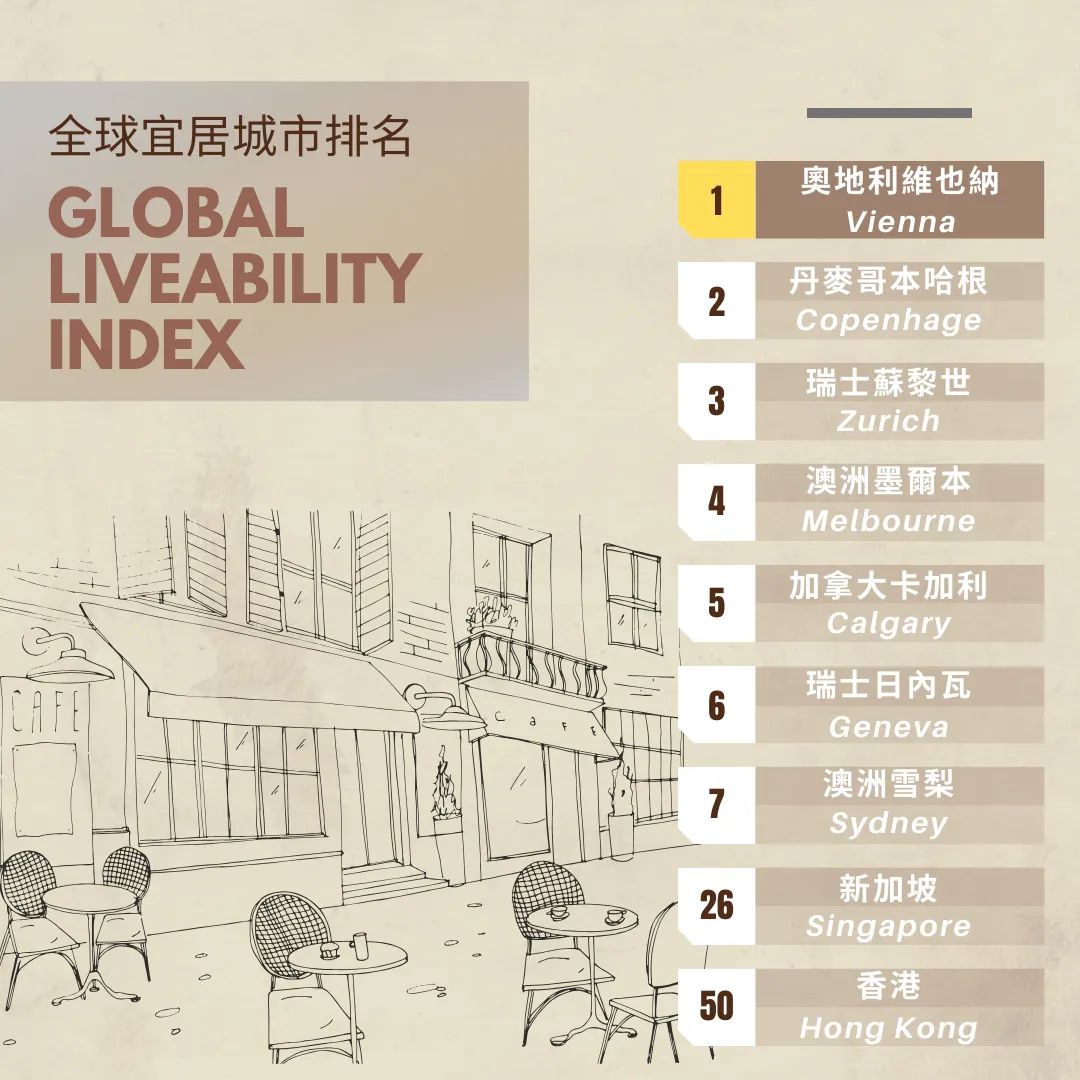
The Global Liveability Index for 2024 by the Economist Intelligence Unit (EIU) of the UK evaluated 173 cities based on stability, healthcare, culture and environment, education, and infrastructure. Once again, Vienna topped the list; followed by Copenhagen, Zurich, Melbourne, Calgary/Geneva (tied for 5th), Sydney/Vancouver (tied for 7th), Osaka/Auckland (tied for 9th). According to the index, Vienna has taken the top spot for the fourth consecutive year, maintaining its leading position among the world's most liveable cities, which are praised for their high-quality public services, excellent healthcare systems, and rich cultural life.
Performance of Asian Cities
- Osaka and Tokyo ranked 9th and 12th respectively; particularly high scores in infrastructure and cultural environment.
- Singapore, although dropped out of the top 20, still ranked 26th, maintaining its leading position in the region.
- Hong Kong has risen significantly by 11 places in this year's report, jumping from 61st last year to 50th.
Why is Hong Kong still only ranked 50th?
However, it is noteworthy that Hong Kong did not rank at the top in this ranking. As an international financial and trade center, the challenges faced by Hong Kong cannot be overlooked, especially in terms of high living costs, air quality, and public health. Although Hong Kong has strong economic power and well-developed infrastructure, its ranking in livability reflects some structural problems, such as housing shortages and social stability challenges.
Conclusion
Such rankings not only make us reflect on the efforts of global cities in improving the quality of life, but also prompt us to think: in international metropolises like Hong Kong, how to balance economic development and the quality of life of residents? As the competition among global cities becomes increasingly fierce, should we re-examine the strategies for enhancing urban livability? These questions are worth deep consideration by every citizen and policy maker.
Letsgethome Key House Breaks Free from Traditional Real Estate Agent Constraints
If you're looking for a way to buy or sell without going through traditional real estate agents, why not try the Letsgethome Key House second-hand property trading platform. This platform allows you to directly engage with property owners, manage the transaction process more easily with better prices, making your property buying or selling process more efficient and transparent!
Free self-listing service https://www.letsgethome.com/zh-HK/listings/new/self-listing