

Hong Kong's 2031 Population Shift: Yuen Long to Top
🎧 Listen to this article
According to the latest population projections for 2031 released by the Hong Kong Planning Department, the population distribution in Hong Kong will undergo significant changes in the next eight years. It is estimated that by 2031, Hong Kong's total population will increase to 7.82 million, an increase of about 3.8% from 7.503 million at the end of 2023. Various districts will experience notable population growth or decline, with areas such as Yuen Long and Kwun Tong becoming hotspots for future population growth, while some central districts like Wan Chai and Yau Tsim Mong face population decline. This trend reflects the challenges Hong Kong faces in urban planning and population aging.
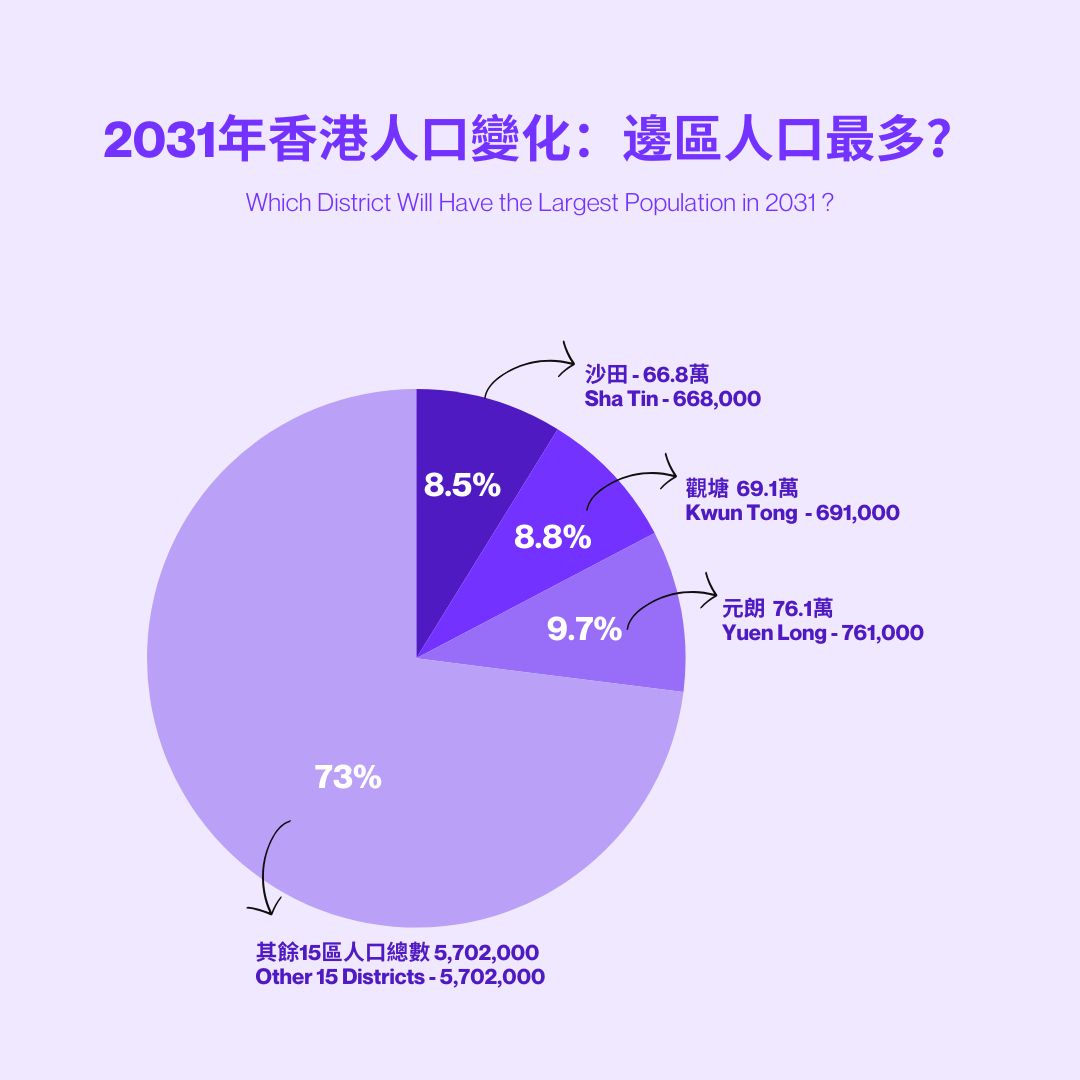
Q: By 2031, which three districts will have the largest population?
According to the Planning Department's projections, by 2031, the population of Yuen Long will reach 761,000, surpassing Sha Tin to become the most populous district. Kwun Tong will rank second with 691,000, and Sha Tin third with 668,000.
Q: By 2031, which three districts will have the smallest population?
The three least populous districts in Hong Kong are Yau Tsim Mong (267,000), Central and Western (223,000), and Wan Chai (146,000).
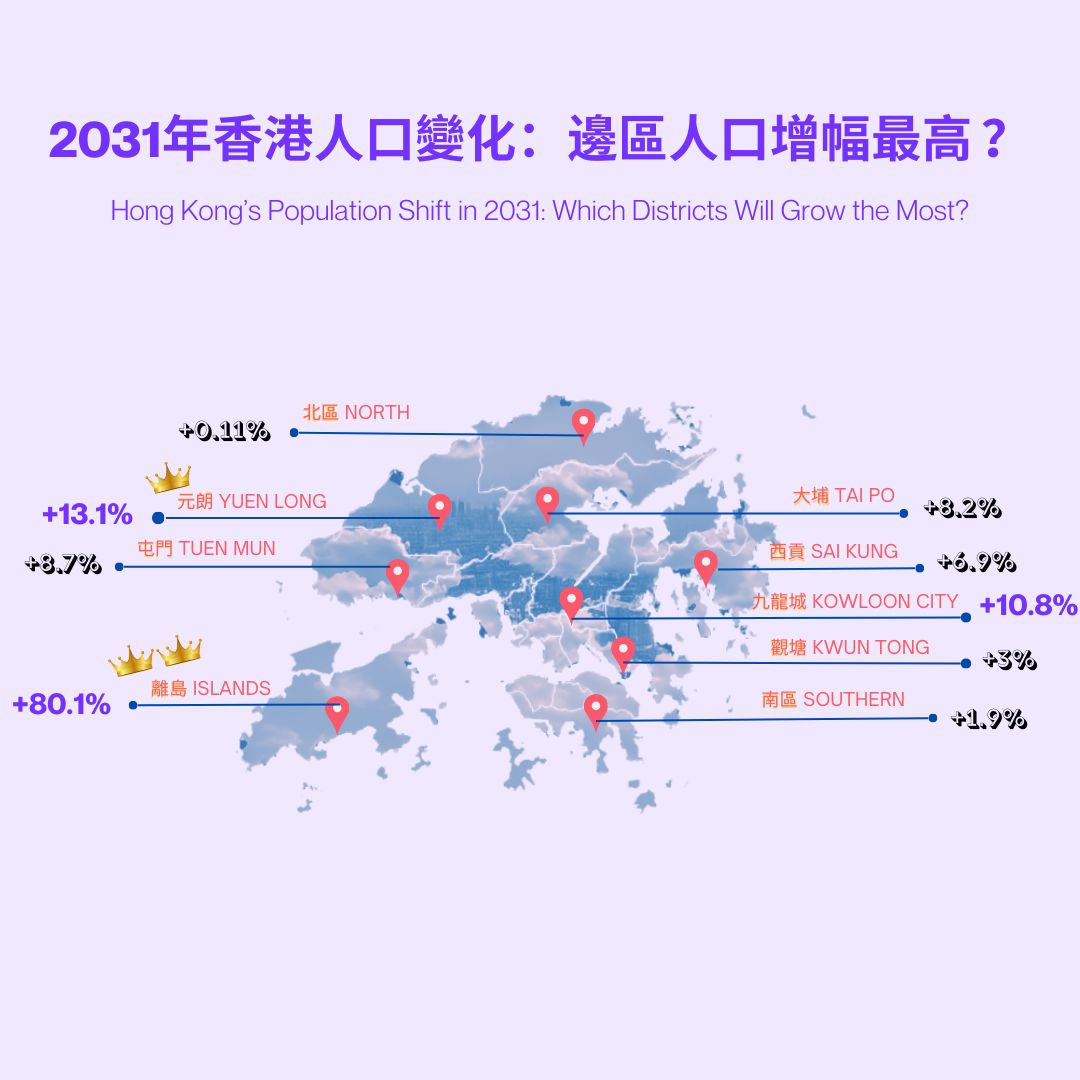
Q: By 2031, which three districts will have the highest population growth?
- Yuen Long's projected population will increase from 673,000 in 2023 to 761,000 in 2031, a net increase of 88,000, indicating rapid population growth in this area. This growth rate not only makes Yuen Long the most populous district but also reflects that with urban expansion and infrastructure development, Yuen Long is becoming an emerging residential and commercial area, attracting more residents.
- Kowloon City's projected population will also grow significantly, from 415,000 to 460,000, a net increase of 45,000. This may be related to redevelopment plans and increased business opportunities in the district, which are particularly attractive to young families.
- Islands District's projected population also shows a net increase, from 196,000 to 353,000, indicating that with infrastructure improvements and increased housing supply, these areas have become future hotspots. Although the population growth figures for Islands District may be higher, the growth rate appears more significant due to the small starting population.
Q: Where can the detailed results of the population distribution projections from 2023 to 2031 be found?
The detailed results of the population distribution projections from 2023 to 2031 are published in the Planning Department's "Population Distribution Projections 2023-2031" report.
| District | 2023 Population | 2031 Population |
|---|---|---|
| Sham Shui Po | 439000 | 439000 |
| Yau Tsim Mong | 304000 | 267000 |
| Kowloon City | 415000 | 460000 |
| Wong Tai Sin | 407000 | 397000 |
| Kwun Tong | 671000 | 691000 |
| Central and Western | 231000 | 223000 |
| Wan Chai | 163000 | 146000 |
| Eastern | 522000 | 467000 |
| Southern | 262000 | 267000 |
| Sha Tin | 703000 | 668000 |
| Tai Po | 317000 | 343000 |
| North | 342000 | 436000 |
| Yuen Long | 673000 | 761000 |
| Tuen Mun | 539000 | 586000 |
| Sai Kung | 504000 | 539000 |
| Islands | 196000 | 353000 |
| Tsuen Wan | 313000 | 296000 |
| Kwai Tsing | 498000 | 483000 |
However, some districts show negative net growth, with populations expected to decline. Yau Tsim Mong, Wan Chai, and Central and Western all show decreasing trends, possibly due to population aging, outflow of young people, and high living costs in central areas.
In summary, the population changes in Hong Kong by 2031 are not merely numerical growth but also represent a shift in future regional development directions. For policymakers, how to respond to these changes will be key to Hong Kong's sustainable development.