

Table of Contents
AC Cooling Tips: Faster Cool, Less Power
🎧 Listen to this article

Hong Kong continues to experience high temperatures, and turning on the air conditioner as soon as you get home seems unavoidable. However, many people habitually set the air conditioner to the lowest temperature to cool down quickly, only to find it ineffective, with the perceived temperature not dropping. A Japanese TV program conducted a real test, and the results showed that another operation can bring coolness faster while significantly saving electricity. Decoration Master summarizes the Japanese test results and professional advice to reveal the most efficient cooling and power-saving tips for air conditioners.
Lowering the temperature cools slowly and consumes more electricity
Faced with high indoor temperatures, many people instinctively set the air conditioner to the lowest temperature, such as 18°C, hoping to feel an immediate chill. However, a real test by a Japanese TV program pointed out that this approach is inefficient and power-consuming.
The experiment was conducted in a room at 36°C:
- Set to 18°C: The air conditioner was set to the lowest temperature, and it took about 7 minutes for the perceived temperature to drop significantly.
- Set to 28°C, maximum fan speed: Keeping a higher temperature but setting the fan to maximum, it took only about 2 minutes to feel a noticeable coolness.
The program also used a thermal camera to observe that when the fan speed was increased, the body surface temperature of the experimenters, as well as the room floor and walls, cooled down faster. The power consumption data was also surprising: when the air conditioner temperature was lowered from 26°C to 25°C and run for 15 minutes, power consumption surged more than double (from 0.14 kWh to 0.32 kWh). In contrast, setting the fan to maximum only slightly increased power consumption (from 0.14 kWh to 0.17 kWh).
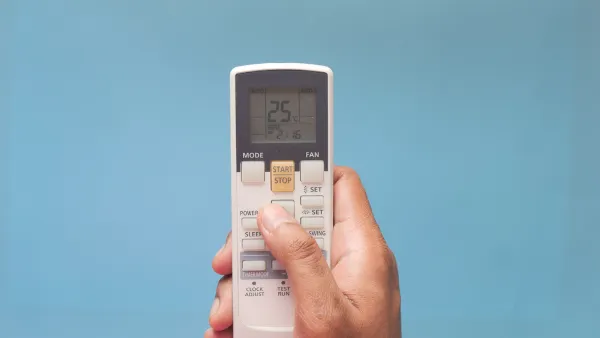
Experts explain that the compressor accounts for about 80% of an air conditioner's total power consumption. Lowering the set temperature forces the compressor to operate under high load for extended periods, making it extremely power-hungry. These real-world tests clearly indicate that simply lowering the temperature not only cools slowly but also significantly increases electricity bills.
Why Does Increasing Airflow Cool More Effectively?
Since lowering the temperature is not the best option, why does 'increasing airflow' cool more efficiently? This involves the physics of air convection.
- Cold air sinks, hot air rises: Cold air is denser than hot air, so it naturally sinks to the bottom of the room; hot air lingers above. If airflow is insufficient, cold air concentrates at low levels, making it hard to mix with the hot air above, resulting in uneven temperature distribution and a less cool feeling.
- Accelerating air convection: When airflow is increased, the strong current from the air conditioner stirs the indoor air, forcing cold and hot air to mix. This 'convection' effect rapidly spreads cold air to every corner of the room while carrying away the hot air above and sending it back to the air conditioner for cooling.
- Quickly lowering perceived temperature: The strong airflow accelerates sweat evaporation on the skin, carrying away body heat—this is why we feel cooler when there is a breeze. By speeding up evaporative cooling, airflow quickly reduces the perceived temperature, making you feel comfortable even if the actual room temperature is slightly higher.
In summary, increasing airflow leverages the physical properties of air to achieve faster overall space cooling and personal comfort with lower energy consumption.
Japanese Air Conditioning Manufacturers Teach: Three Golden Rules for High Efficiency and Energy Saving
Facing hot weather, how to stay cool and save electricity? Two major Japanese air conditioner brands, Fujitsu and Daikin, shared the following key suggestions based on their professional research and tests:
1. Start with "High Fan Speed", then switch to "Auto Mode"
When you first get home, the room temperature is usually high. At this time, do not directly set the temperature to the lowest.
Recommended approach:
- Initial startup: Set the air conditioner's "fan speed" to maximum. This allows cool air to circulate quickly indoors, reducing the perceived temperature in a short time.
- After feeling cool: Switch the fan speed setting to "Auto Mode". The air conditioner will intelligently adjust the fan speed and compressor power based on the room temperature and set temperature, maintaining a constant temperature in the most energy-efficient way.
Principle: "Auto Mode" initially uses high fan speed to cool down quickly, then switches to low-power operation once the set temperature is reached, saving more electricity than running at low fan speed continuously. Daikin's experiments show that long-term use of "Auto Mode" can save about 30% on electricity bills compared to "Low Fan Mode".
2. Make good use of electric fans or circulation fans to promote indoor air circulation
Relying solely on the air conditioner's airflow may not cool the entire room evenly; using auxiliary tools can be more effective.
Recommended approach:
- Place an electric fan or circulation fan below the air conditioner's air outlet, or point it toward the center of the room.
Principle: The fan can send the cool air from the air conditioner to farther corners, promoting air circulation and convection throughout the room, accelerating the mixing of hot and cold air. This allows you to feel cool enough even if you raise the air conditioner temperature by 1-2°C, thereby reducing the air conditioner's power consumption. At the same time, the airflow from the fan also helps lower the perceived temperature.
3. Set an appropriate temperature: Each 1°C increase saves nearly 10% on electricity
Setting the temperature too low not only consumes electricity but is also unhealthy.
Recommended approach:
- Set the air conditioner temperature between 26°C and 28°C, and use it with an electric fan.
Principle: According to data from the Japanese Institute of Industrial Technology, for every 1°C increase in air conditioner temperature, about 6% to 10% of electricity costs can be saved. In Hong Kong's hot weather, 26°C to 28°C combined with a fan can provide sufficient cooling, avoiding overloading the compressor.
From renovation quotes to before and after moving in, comprehensive support at every step!
>> Get a free renovation quote: https://hkdecoman.com/measure
>> Book a home clinic (inspection/cleaning/repair): https://clinic.deco-x.com/
Special sections for various housing types:
>> Public housing https://decoman-publichousing.com/
>> Private housing https://decoman-privatehousing.com/
>> New properties https://decoman-newproperties.com/
>> Tenement buildings https://decoman-tenement.com/
================================================================
*** This article is reprinted with permission from 裝修佬 ***