
Table of Contents
Smart Home Renovation: Avoid Contract Pitfalls
🎧 Listen to this article

Renovating a new home should be a joyful experience, but many homeowners, due to a lack of experience, can easily fall into traps of project delays, budget overruns, or even unfinished work if they are not careful when signing contracts. Signing a renovation contract is the crucial first step to protect both parties. Renovation Expert will break down the key considerations before signing, from selecting a company and reviewing quotations to establishing terms of responsibility, helping you become a savvy homeowner and complete your renovation smoothly.
Choosing the Right Company is Half the Battle: How to Screen Reliable Renovation Partners?
The quality of a renovation project largely depends on the partner you choose. During initial contact, besides admiring design portfolios, you should also deeply understand their background and reputation.
- Check Past Performance: Actively ask the company for past renovation case studies, especially projects similar to your unit type (such as public housing, village houses, or specific estates). This is because different types of buildings have varying renovation regulations and process limitations.
- Understand Company Background and Insurance: Choosing a registered renovation company offers relatively more security. Most importantly, homeowners must ensure the company purchases "Labor Insurance" and can request them to arrange "Third-Party Liability Insurance." This cost is small but absolutely cannot be skimped on. In case of unfortunate accidents causing losses during renovation, it can handle substantial compensation, protecting yourself and others.

Tip: All important communications, agreements, and decisions must be recorded in writing (e.g., via WhatsApp) to have evidence in case of disputes.
The Devil is in the Details: How to Decipher a Quotation?
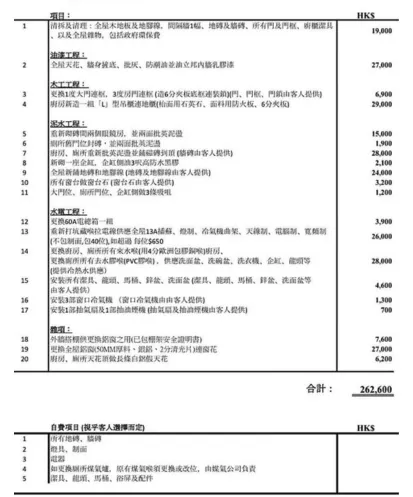
A clear and detailed quotation is the foundation for avoiding future disputes. After receiving a quotation, do not just look at the total price; you must carefully examine every detail.
- Comprehensive Itemization: A professional quotation should specify the scope of work, craftsmanship, materials, and price for each process. For example, for waterproofing work, it should note the location, materials used, height of the waterproof layer, and whether a water test will be conducted.
- Material Brands and Specifications: For the "labor and materials included" parts of the quotation, you must clarify the brands and origins of the "base materials" included, such as paint, copper water pipes, waterproofing materials, etc. Poor-quality base materials can severely affect the durability of the project and must be handled carefully. For "surface materials" like tiles and flooring, even if purchased by the homeowner, they should be communicated with the contractor before signing to avoid construction issues or extra costs due to material characteristics.
- Watch for Hidden Charges:
◦ Power Outlet Calculation Methods: Calculation methods for power outlets vary in the market; you must ask the company to clearly explain them before signing to avoid budget surprises.
◦ Additional Construction Fees: Quotations are generally based on standard craftsmanship. Special requests may involve extra charges, which should be inquired about in advance.
◦ Installation Fees: Whether installation fees for items purchased by the homeowner, such as sanitary ware and lighting fixtures, are already included must also be clearly stated in writing.
⬆️ Online Image
Tip: Do not just choose the lowest-priced quotation; carefully compare each detail to guard against the trap of "cheap first, expensive later."
Black and White is Most Practical: Rights, Responsibilities, and Terms to Discuss Before Signing
A contract is not just confirmation of a quotation; it is a document that regulates the rights and obligations of both parties. As the saying goes, "Be a villain first, then a gentleman." Clearly establishing the following terms before signing can effectively reduce future disputes.
- Handling of Project Delays: Clearly define what constitutes a "delay," as well as the responsibility and handling methods for delays caused by the contractor or the homeowner.
- Payment Methods and Installments: The mainstream payment method is installment payments, such as "4321" or "3331." The initial payment (deposit) should ideally not exceed 30% of the total amount. Subsequent payments should be tied to clear project milestones, for example:
◦ Second Installment: Pay after completing masonry work
◦ Third Installment: Pay after painting is completed and custom furniture is delivered
◦ Final Payment (Last 10%): Pay only after completion and acceptance
- Acceptance Standards and Warranty Period: Both parties should have reasonable consensus on acceptance, e.g., (for paint, generally inspected from 1 meter away) walls should be smooth, color even, and corners intact. At the same time, the contract should also specify the warranty period and scope for the work. The warranty period generally ranges from six months to one year and needs to be clearly agreed upon as starting from the "handover of keys date" or the "date the homeowner pays the final balance."

Tip: The payment criteria for each installment (e.g., which project milestone is completed) must be clearly quantifiable; avoid using vague wording like "thirty days after commencement" or "30% completion of the project."
Professional Platforms Make Renovation Simpler
Reading this far, you might find the process complicated. In fact, the preparatory work before renovation is not simple at all—from screening companies from scratch, comparing quotations with numerous details, to supervising the project—it is indeed a significant challenge.
"Renovation Expert", as a one-stop renovation platform, precisely addresses these pain points by providing assistance to help homeowners easily tackle renovation difficulties:
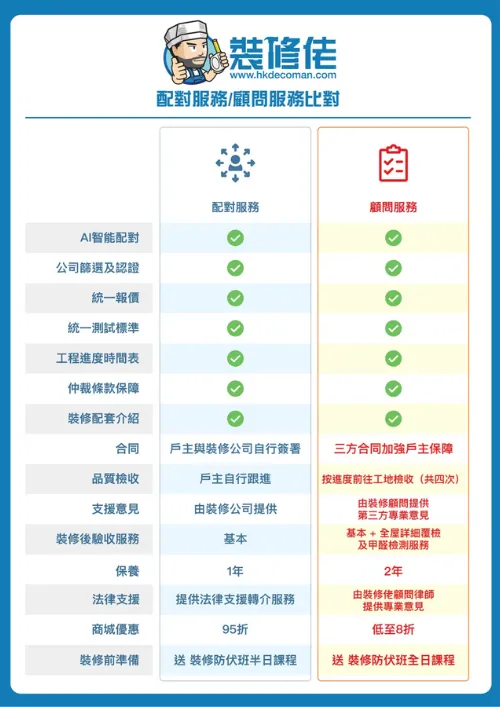
- Smart Matching Service: Based on the homeowner's budget, design style, and project needs, matches rigorously vetted, high-performing renovation/design companies through a vast database and intelligent system.
- Unified Format Quotations: Provides quotations in a unified format, clearly listing each item, allowing homeowners to easily compare fees from different companies and avoid being misled by hidden charges due to inconsistent formats.
- Professional Consultant Support Service: From matching to project completion, experienced renovation consultants can provide full follow-up and offer professional, neutral advice, assisting smooth communication between homeowners and renovation companies to ensure project success.
【Register Now for Free Renovation Measurement】
Comprehensive one-stop support from renovation quotation to move-in and beyond!
>> Get Free Renovation Quotation: https://hkdecoman.com/measure
>> Book a Home Clinic (Inspection/Cleaning/Repair): https://clinic.deco-x.com/
Specialized Sections for Various Property Types:
>> Public Housing https://decoman-publichousing.com/
>> Private Housing https://decoman-privatehousing.com/
>> New Developments https://decoman-newproperties.com/
>> Tenement Buildings https://decoman-tenement.com/
================================================================
*** This article is reprinted with permission from Renovation Expert ***