

Table of Contents
Dehumidifier Fire Risks: Safety Tips You Must Know
🎧 Listen to this article
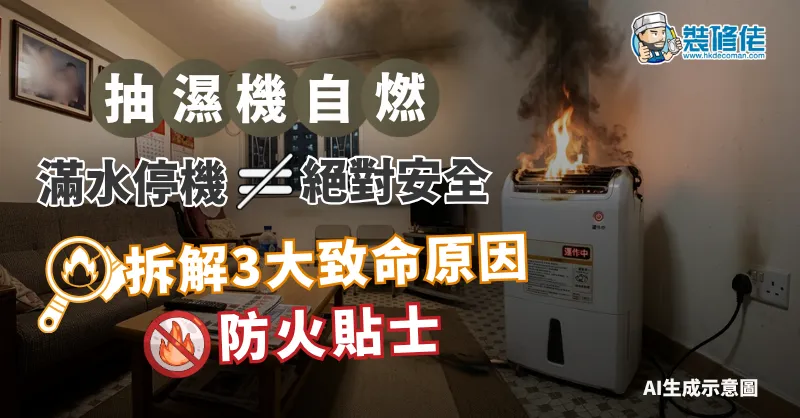
The weather in Hong Kong is humid, especially during the "return of moisture" season and the rainy season. Dehumidifiers are almost a must-have appliance in every household, and many people are accustomed to running them 24 hours a day, even when they are out or sleeping. However, this seemingly ordinary habit may conceal a fatal fire risk. A recent real case of a dehumidifier spontaneously combusting in Taiwan serves as a wake-up call. Decorator has compiled opinions from a local firefighter and the Electrical and Mechanical Services Department, along with practical prevention strategies to help you ensure home safety.
Automatic Shut-off When Full Is Not "Absolutely Safe"
A firefighter known as "Fire God's Tablet" in Taiwan shared a fire incident on social media. He said that when firefighters arrived at a third-floor room, the fire had already been extinguished. The scene showed only a severely burned dehumidifier with a charred and deformed shell, and burn marks on the floor. Fortunately, because there were no other combustible materials in the room, the fire did not spread. The homeowner, like many others, believed that "the dehumidifier automatically shuts off when the tank is full, so it is very safe," and thus habitually left it running continuously even when no one was home or while sleeping. However, this case clearly points out a fatal blind spot: "The spontaneous combustion of a dehumidifier has absolutely nothing to do with whether the tank is full." Even if the machine appears to be operating normally, its internal components may have already deteriorated due to aging, laying the groundwork for disaster.
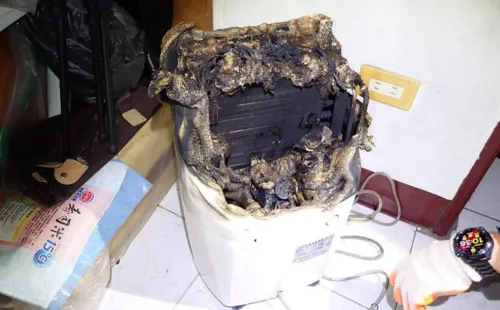
Image source: Yahoo News
Why Do Dehumidifiers Spontaneously Combust?
Why does a dehumidifier still catch fire even when it automatically shuts off when the water tank is full? The key lies in its operating principle and heat dissipation mechanism. When a dehumidifier is running, its internal compressor and motor continuously generate a large amount of heat. Under normal circumstances, this heat is expelled through the air intake and exhaust vents along with the dry air. However, when the cooling mechanism fails, disaster begins to brew.
That firefighter summarized three main causes of overheating:
- Dust accumulation blocking the filter: Dust, hair, and lint in the humid air easily stick to the machine's filter screen. If not cleaned for a long time, the accumulated dust can become as thick as a cloth, severely blocking the air intake. At this point, the amount of incoming air is greatly reduced, but the compressor continues to run at full capacity, causing the generated heat to be unable to dissipate and continuously accumulate inside the machine.
- Aging of the machine: Old dehumidifiers used for seven or eight years or even more than a decade are "invisible killers." Even if the exterior looks good, the internal circuit boards, capacitors, motor coil insulation, and other parts have already aged and deteriorated. Aged components are more prone to failure under high temperatures, such as capacitor bursting, insulation material softening and cracking, which can eventually lead to short circuits or arcing, igniting the machine body.
- Prolonged operation: Even if the machine shuts off when the water tank is full, the internal electronic components may still be energized, and heat continues to accumulate. If combined with filter blockage and component aging, prolonged operation undoubtedly creates perfect conditions for a fire. The entire process may occur slowly over several hours or even days, with no unusual sounds or smells beforehand, only to be discovered when the fire breaks out.
Dehumidifier Short Circuit Causes Fire in Wang Tau Hom Estate Unit
Similar accidents have also occurred in Hong Kong. In the early morning of March this year, a serious fire suspected to be caused by a dehumidifier broke out in a mid-level unit at Wang Yiu House, Wang Tau Hom Estate, Wong Tai Sin. According to reports, the 35-year-old male resident turned on the dehumidifier before going to bed. At around 3:30 a.m., the dehumidifier suddenly caught fire, quickly igniting clutter in the living room.
The male resident woke up and tried to put out the fire himself but failed, resulting in burns to his hands, feet, and face. He eventually had to escape with his wife and mother, who had inhaled smoke. The fire spread uncontrollably, engulfing the entire unit in flames, causing severe damage, and blackening the exterior wall. The incident sent four people, including the resident's family, to the hospital, and about 300 residents needed emergency evacuation. Preliminary investigation by the fire department believed that a short circuit in the living room dehumidifier's electrical wiring caused the fire. The Electrical and Mechanical Services Department later conducted an on-site investigation and also suspected that the accident was caused by dehumidifier overload or mechanical failure.

Screenshot source: now news
Prevention: Three Safety Rules
To safely use a dehumidifier, you must completely change bad habits and perform regular maintenance.
1. Establish Correct Usage Habits
- Before going out or sleeping, simply pressing the off button is not enough; you must unplug the power cord to eliminate the risk of internal components overheating due to continuous power supply. Avoid running the dehumidifier 24/7.
- Use a Dedicated Outlet: Dehumidifiers are high-power appliances. Use a dedicated fixed outlet directly, and never connect to a power strip for convenience, to avoid electrical overload.
2. Perform Regular Maintenance and Inspection
- Clean the Filter Regularly: Clean the filter at least every two weeks and let it dry completely before reinstalling. This is the most critical step to ensure proper heat dissipation and prevent overheating.
- Ensure Adequate Ventilation: Leave at least 50 cm of clearance around the unit. Do not place it against walls, furniture, or hang dripping clothes above it, as this may block the air intake and outlet. Also, place it away from flammable materials.
3. Stay Alert and Replace When Necessary
- If you notice abnormal burning smells, unusual noises, excessive heat, or unexpected shutdowns during operation, these are signs of malfunction. Stop using it immediately and unplug it.
- Set a Service Life: Dehumidifiers over eight years old have severely aged internal parts, significantly increasing fire risk. Consider replacing them decisively.
【Editor's Picks】
Comprehensive support from renovation quotes to moving in!
>> Get a Free Renovation Quote: https://hkdecoman.com/measure
>> Book a Home Clinic (Inspection/Cleaning/Repair): https://clinic.deco-x.com/
Specialized sections for different property types:
>> Public Housing https://decoman-publichousing.com/
>> Private Housing https://decoman-privatehousing.com/
>> New Developments https://decoman-newproperties.com/
>> Tenement Buildings https://decoman-tenement.com/
================================================================
*** This article is republished with permission from 裝修佬 ***