
Table of Contents
Simple Housing Ordinance: Key Dates and Standards Guide
🎧 Listen to this article
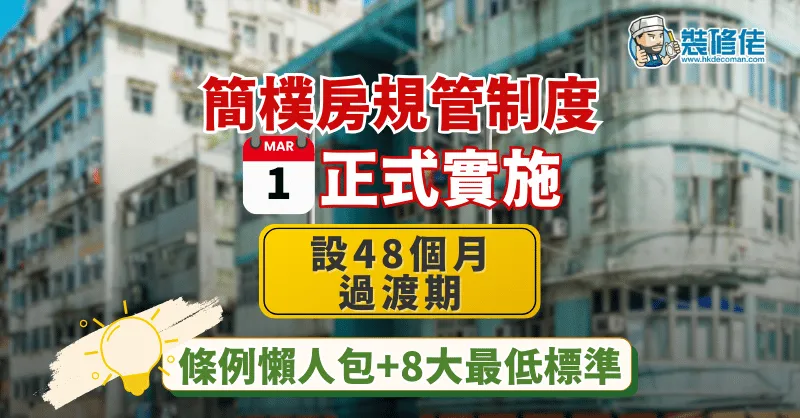
The regulatory system under the "Simple Housing Ordinance" will officially take effect on March 1st. It is reported that some landlords have already started reclaiming units for renovation. How should landlords apply for certification for their units? What are the standards for the living environment? Renovation Expert has compiled a summary of the key points of the ordinance, making it easy for you to grasp all the essential information.
48-Month Transition Period: Landlords Can Waive Application Fees by Registering Early
The government has established a transition arrangement lasting up to 48 months. After the regulatory system officially launches, landlords can register their existing subdivided units with the government for free during the first 12-month "registration period." Upon completion of registration, the units will then receive a 36-month "grace period." During this time, landlords can continue to rent out the units and use this period to carry out necessary renovation works to meet the minimum standards for "Simple Housing."
All subdivided units must in the future comply with the minimum standards and obtain "Simple Housing" certification to be legally rented out. It is worth noting that if landlords can complete the renovation and apply for certification for their units within the first 3 years, they can also have the relevant application fees waived. This measure aims to encourage landlords to take action early to improve unit quality.

Screenshot source: Housing Bureau
Ho Wing-yin: Approximately 4,000 Transitional Housing Units Reserved for Affected Subdivided Flat Tenants
As the new regulations are about to take effect, some landlords have already begun reclaiming units for renovation, and many affected subdivided flat tenants are worried about finding similarly priced accommodation in the same district. In response, Secretary for Housing Ho Wing-yin stated in a radio interview that the government has reserved approximately 4,000 transitional housing units for subdivided flat tenants who may be affected by the ordinance to apply for, serving as a buffer.
Ho Wing-yin further pointed out that she understands tenants' desire to "settle in the same district," so the bureau is actively studying ways to increase the supply of transitional housing in urban areas. She revealed that the authorities are reviewing the feasibility of converting a school building near Kwun Tong into transitional housing. If the plan proceeds, it is expected to provide over 100 units, complete with facilities like a hall and activity rooms, making it particularly suitable for families with children. At the same time, she also called on private landlords with suitable units to proactively contact the government to jointly provide more transitional housing options for citizens in need.

Image source: HK01
"Simple Housing" Regulatory System Summary
For landlords holding subdivided units, understanding every detail of the new system is crucial. Below is a synthesis of the Housing Bureau's official information to help landlords clearly plan their next steps.
Transition Arrangements and Key Timelines
- Registration Period (12 months): From March 1, 2026, to February 28, 2027. Landlords of existing subdivided units can register for free during this period to obtain the grace period.
- Grace Period (36 months): From March 1, 2027, to February 28, 2030. Registered units can carry out renovation works and apply for certification during this period.
- Enforcement Begins: From March 1, 2027, renting out any subdivided unit that is not registered or certified will be illegal.
- Countdown Period: The last 6 months of the grace period (September 1, 2029, to February 28, 2030). Registered units that have not yet obtained certification cannot enter into new tenancy agreements.
- Full Enforcement: From March 1, 2030, all rented subdivided units must hold a valid "Simple Housing" certification.
How to Obtain "Simple Housing" Certification?
- Application Time: Applications accepted starting March 1, 2026 (relevant forms).
- Core Requirement: The unit must be certified by a registered architect, engineer, surveyor, or other "specified professional" (must be privately engaged) to prove it complies with all minimum living environment standards.
- Application Fee: $3,000 per subdivided unit. An "early bird" discount waives the fee for applications within the first 3 years (March 1, 2026, to February 28, 2029).
- Certification Validity: Valid for 5 years, renewable before expiry for a fee of $2,400.
Image source: Housing Bureau
"Simple Housing" 8 Major Minimum Living Environment Standards
To successfully obtain certification, subdivided units must comply with the following eight minimum standards stipulated by the Code of Practice:
- Minimum Internal Floor Area: The area within the enclosing walls of the unit must be at least 8 square meters (approximately 86 square feet).
- Minimum Height: The height from floor to ceiling must be at least 2.3 meters; if there is a beam below, the height from floor to the underside of the beam must also be at least 2 meters.
- Fire Safety: The unit must provide access to at least two escape staircases (except for single-staircase buildings). If the original entrance fire door is retained, the corridor width must be not less than 0.75 meters; if removed or if the fire door does not meet standards, the corridor width must be not less than 1.05 meters. Each subdivided unit and common corridor must be equipped with an independent fire detector and fire extinguisher.
- Load-Bearing: Works such as added partition walls and floor structures must comply with the building's load-bearing capacity standards and, following the simplified provisions of the "Minor Works Control System," engage prescribed building professionals / prescribed registered contractors for design and supervision of the works.
- Independent Toilet: The unit must have a dedicated, enclosed, and waterproofed toilet. The floor and walls must have a waterproof layer.
- Water Supply Point and Wash Basin Outside Toilet: A water supply point and wash basin must be provided outside the toilet, with a waterproof layer installed in the nearby area.
- Lighting and Ventilation: The living space must have at least one openable window (with a glass area of not less than 0.1 square meters facing outdoors), an artificial lighting system, and mechanical ventilation facilities providing air changes of not less than 5 times per hour; "windowless toilets" must have an effective exhaust system.
- Independent Water Meter and Independent Electricity Meter: The unit must be equipped with independent water and electricity meters provided by the Water Supplies Department and the power company to ensure clear usage calculation.
For detailed information, visit the Housing Bureau webpage
Comprehensive one-stop support from renovation quotation to move-in and beyond!
>> Get a Free Renovation Quotation: https://hkdecoman.com/measure
>> Book a Home Clinic (Inspection/Cleaning/Repair): https://clinic.deco-x.com/
Specialized sections for various housing types:
>> Public Housing / Home Ownership Scheme https://decoman-publichousing.com/
>> Private Buildings https://decoman-privatehousing.com/
>> New Developments https://decoman-newproperties.com/
>> Tenement Buildings https://decoman-tenement.com/
================================================================
*** This article is reprinted with permission from Renovation Expert ***